
What This Insight Argues About SMEs in Jordan
The argument in brief
- Small firms in Jordan find it harder to climb than they should, because big contracts go to big vendors.
- Below the top, they compete through two channels: price, which ends in a race to the bottom, and connections, which only work for the connected.
- The firms that escaped moved up from execution to advice, and priced on value.
- Brand advocacy is how a small firm makes that move: merit made visible through the people who vouch for it.
Why Small Businesses in Jordan Struggle to Climb
Jordan’s economy has a hollow middle. Almost 9 in 10 firms are microenterprises, yet medium and large firms, about 2% of all firms, employ more than 60% of workers. The ladder between the two is short on rungs. Growing across that gap is harder than it should be. Small firms need bigger clients to grow, and bigger clients mostly buy from firms that are already big. Late payment makes it worse. The IMF has urged Jordan to tackle late payments across the supply chain, and small suppliers can least afford to wait.Big Companies in Jordan Win the Contracts That Matter
The public market shows the pattern most clearly. Between 2018 and 2022, 1% of companies took 60% of the value of public procurement. Everyone else works off what is left. The rules don’t help a small firm stand out on quality. For small purchases, the contract goes to the lowest-priced compliant bidder, and specifications may not name a brand. Even the state’s support comes as price margins. Firms owned or run by women or young people get up to 5%, and Jordanian industrial products get 20%. Price is the language the system speaks.A Price War at the Bottom of the Market
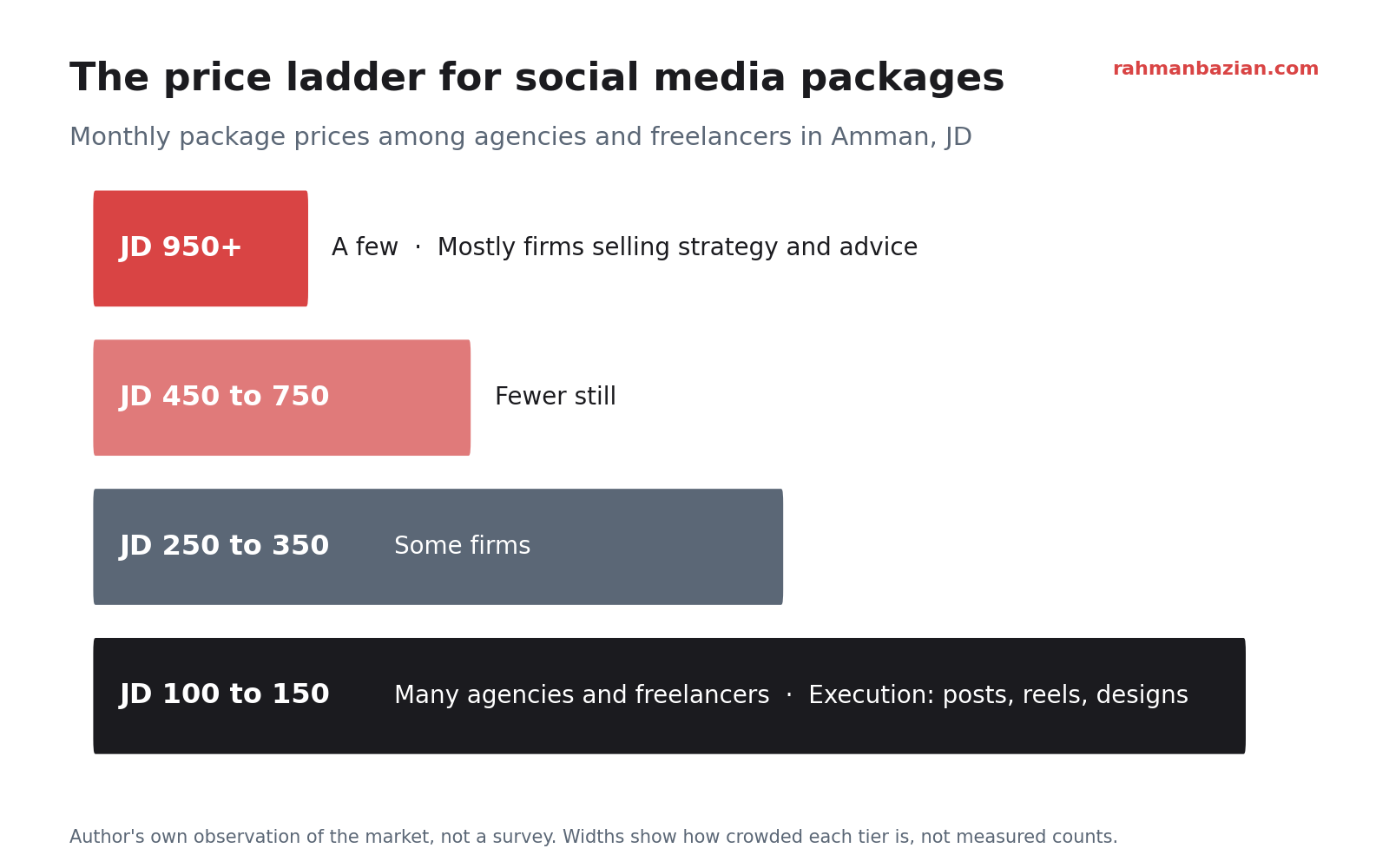
Below the big contracts, the price war is out in the open. You can watch it on social media every day. Pet shops undercut each other post by post. Studios sell reels at JD 10 each just to win a client. Websites are advertised from $100. Social media management shows how the market sorts itself. From what I see across agencies and freelancers in Amman, prices fall into four tiers:
The price ladder: monthly social media packages
That pattern is the point. The bottom tier is crowded because the work is easy to compare and easy to copy. At the top, it’s thin because it sells judgment, and judgment is bought from people you trust.
- JD 100 to 150: where many agencies and freelancers sell.
- JD 250 to 350: some firms.
- JD 450 to 750: fewer still.
- JD 950 and above: a few, usually those selling strategy and advice, not just posts.
Nobody Admits the Real Price War Meaning
Price war meaning: a cycle of competitors cutting prices to win or keep customers, until margins shrink for everyone. The first cut is meant to be temporary. It rarely is.
Firms rarely think they’re in one. Cardot and Boland studied pricing managers and found they don’t count value-adjusted price competition as a price war. Yet that’s exactly what it is. The studio that throws in two extra reels “just this month” is already fighting one.
Rao, Bergen and Davis warned about this back in 2000. Price had become the weapon of choice, and skirmishes often turned into price wars. The research is old, but the pattern hasn’t changed.
Price Wars Examples From Jordan’s Largest Firms
Price wars don’t spare the big players either. When a fourth cement plant opened in 2011, capacity reached about 10 million tonnes a year against demand of about 3.5 million. One of the incumbents, Lafarge Jordan, later filed for insolvency with accumulated losses of about JD 120 million against JD 60 million in capital. Mobile telecom went through its own squeeze. Sector revenue fell 8% between 2011 and 2013, as fierce competition met a rising tax burden. Orange Jordan’s EBITDA fell 29.5% in 2013. All three operators survived, but the lesson holds: if price wars hurt firms this size, small ones have no margin to lose.Key Numbers on Small Firms and Big Companies in Jordan
The squeeze in five numbers
Put together, these numbers describe a market where cutting prices is the easiest move and the worst one.
- About 88% of Jordanian firms are micro, while about 2% employ more than 60% of workers.
- 1% of companies took 60% of public procurement value between 2018 and 2022.
- 50.2% of formal firms compete with informal businesses, against 41% across the region.
- 39% of firms name access to finance as their biggest obstacle, and 65.9% of investment is self-funded.
- More than 80% of Checkers Inc. contracts since 2018 started with the client reaching out.
Small Firms Know the Wasta Meaning Too Well
The other channel is connections. Wasta, the Arabic word for using personal ties to get access, is part of daily life. In a 2019 survey, 25% of Jordanians used it to reach public services. For companies, it decides who hears about a contract before it is announced. For a small firm without the right ties, wasta is a closed door. It also damages the market it operates in: research on Jordanian manufacturing found wasta has negative consequences for long-term buyer and supplier relationships. Trust itself is a different matter. A study of 534 procurement managers in North Africa found that trust and reciprocity improve business relationships. The problem is not relationships. It’s access that isn’t earned.| Wasta | Brand advocacy | |
|---|---|---|
| What drives the introduction | Who you are to them | Their own experience of your work |
| Who it works for | The already connected | Anyone whose clients speak for them |
| What it rewards | Who you know | What you deliver |
| What it does to the market | Weakens long-term relationships | Builds them |
Table 1: Wasta and brand advocacy compared.
Put simply, brand advocacy is merit-based wasta. Someone still lobbies for you, but because they have used your product or service themselves. Their own experience drives the introduction, not who you are to them.How Value Based Pricing Lifts Firms Out of Execution
The big agencies and consultancies in Jordan don’t join the price war. They rose above execution to sell strategy, advice and judgment, and they price on the value of the outcome, not the cost of the hours. That only works when the client trusts you. Les Binet, a leading researcher on marketing effectiveness, puts it simply. The stronger the brand, the lower the price elasticity and the greater the pricing power. His evidence comes mostly from consumer markets, but the logic carries over. A small studio can’t announce that it now sells strategy. It has to be believed first. That is where most attempts to move up stall.Making Merit Visible Through Brand Advocacy
Brand advocacy is the third channel. It means people inside and outside a buying company knowing you, trusting you and recommending you before you pitch. Advocacy turns a track record into something others carry into rooms you can’t enter. The introduction comes from someone’s own experience of your work. It also takes you out of the price comparison. Business buyers rarely pay more for business value alone: only 14% will pay a premium for it. But they are eight times more likely to pay one when there is personal value, when someone they trust has put their name behind you. That research is from 2013, but it matches buyers today. Now, 95% of purchases come from a shortlist drawn up before the first sales call. For a small firm, advocacy does what a bigger name does for a big one. Among US decision-makers, 53% say brand recognition matters less when a company’s thinking is good.
From inside Checkers Inc.
Since we founded Checkers in 2018, more than 80% of our contracts have started with the client reaching out to us. Usually it was someone influencing the decision, gathering options for the people who sign off. We were on the shortlist before any pitch, and we were not competing on price to get there.
That’s one firm’s records, not a survey. But it is how we climbed.
The method is simple to describe and slow to build. Solve a problem for the individual first, earn their trust, and let them bring you into their company. The step-by-step version is in our guide, Brand Advocacy Done Right.
The Bottom Line on the Price War for SMEs in Jordan
A small firm can’t win a price war against a market this crowded, and it can’t buy connections it doesn’t have. It can build people who vouch for it. That is the one way up that rewards the work itself.Takeaways for Small Businesses in Jordan Stuck on Price
- Stop treating price cuts as temporary. Each one teaches clients what your work is worth.
- Move up from execution to advice. Sell the judgment behind the reel, not the reel.
- Earn access instead of borrowing it. Advocacy lasts longer than a favor.
- Start with individuals. The person you help today brings you into their company tomorrow.
- Get known before the tender. In public buying, reputation has to work before the scoring starts.